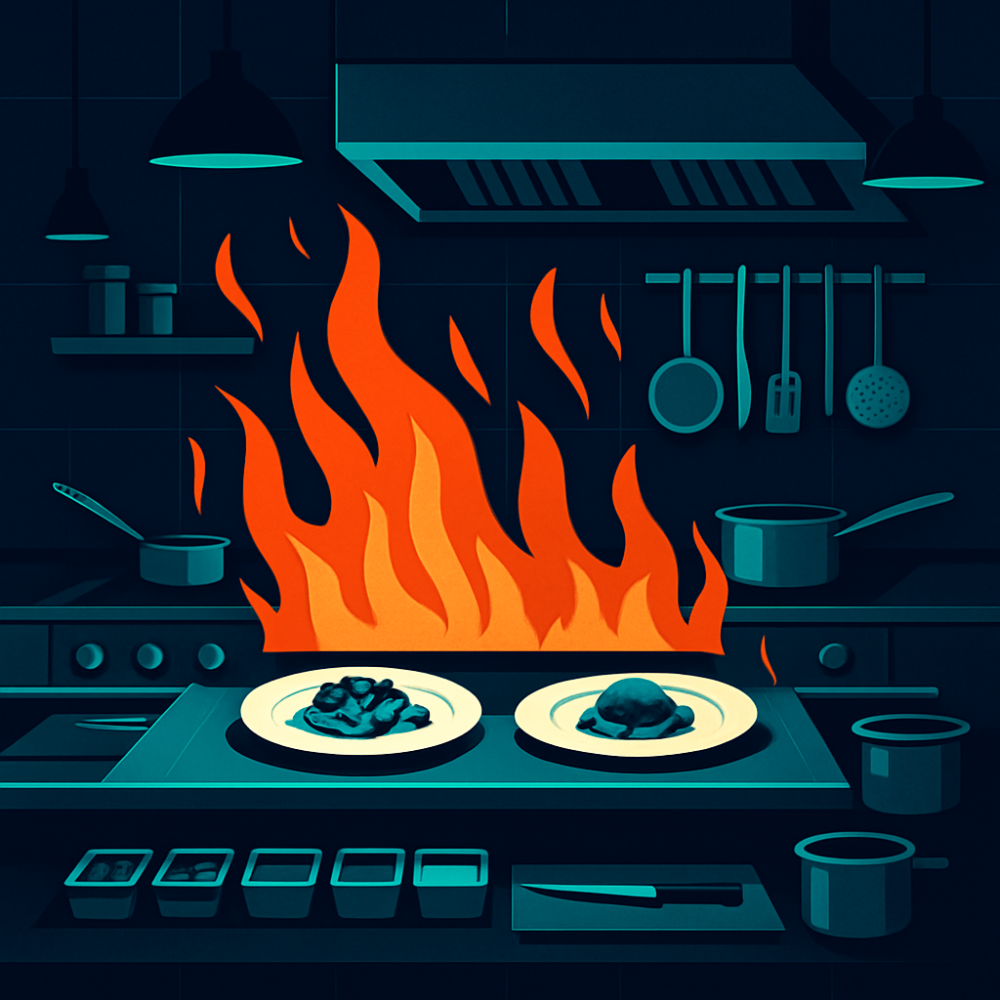
What Being a Top Chef Can Teach Today's Business Leaders
The professional kitchen is one of the most demanding environments on earth — and one of the best leadership classrooms. Here are seven lessons from the world's top chefs that apply directly to running a high-performing organisation.
Series: Leadership, Post #11
TelevisionThis post includes a Leadership Brief — an exclusive extended version.
What Being a Top Chef Can Teach Today’s Business Leaders
Lessons in Leadership, Pressure, and Excellence from the Professional Kitchen
The professional kitchen is one of the most demanding environments on earth. It is hot, fast, unforgiving, and entirely dependent on a team of people performing at their best under relentless pressure. Service does not pause because someone is having an off day. The orders keep coming, the plates keep going out, and the standard never drops.
It strikes me that this is not so different from running a business. The stakes feel high, the margins are tight, the customer is watching, and your team is only ever as strong as its weakest moment. Whilst the worlds of haute cuisine and corporate leadership might appear miles apart, the very best chefs have a great deal to teach those of us who lead organisations. Here’s a look at what we can learn.
1. Mise en Place — Preparation Is Everything
Ask any serious chef about the secret to a smooth service and they will say two words: mise en place. Literally “everything in its place”, it is the discipline of preparing and organising every ingredient, tool, and station before the first order lands.
The lesson for business leaders is obvious but frequently ignored:
- Front-load the thinking: The work you do before the pressure arrives determines how you cope when it does. Strategy, planning, and process design are your mise en place.
- Reduce decisions under fire: A chef who has prepped properly is not making frantic choices mid-service. They are executing. Leaders who prepare well spend a crisis acting, not scrambling.
- Order creates speed: Counter-intuitively, the most disciplined kitchens are the fastest ones. The same is true of well-run teams.
In my opinion, far too many organisations celebrate firefighting whilst quietly neglecting the prep work that would have prevented the fire in the first place.
2. Standards Are Non-Negotiable
A great chef will send a plate back to the pass if it is not right — even if it costs time, even if the table is waiting. The standard is the standard, and everyone in the kitchen knows it.
- Consistency is the brand: A restaurant is only as good as its worst plate on its worst night. Your business is only as good as your worst customer interaction.
- The leader sets the bar: Teams calibrate to what their leader tolerates, not to what they say they want. If you accept “good enough”, that is what you will get.
- Quality is a habit, not an event: Excellence is not something you summon for the big moments. It is the default you build through hundreds of small, repeated choices.
3. Calm Under Pressure Is a Skill, Not a Trait
The best head chefs are not the ones shouting the loudest. The truly exceptional ones bring a steady, controlled focus to the chaos. Pressure is constant in a kitchen, and the leader’s composure sets the emotional temperature of the entire team.
- Panic is contagious — but so is calm. Your team reads you before they read the situation.
- Clarity beats volume. Clear, decisive instruction does far more than raised voices.
- Pressure reveals preparation. Composure under fire is usually evidence of the prep work done long before.
I am always conscious that a leader’s mood is rarely a private matter. It ripples outward, for better or worse.
4. Everyone Owns Their Station
A kitchen brigade works because every member owns their section completely. The person on the grill is not waiting to be told what to do — they know their responsibilities, they own their outcomes, and they are accountable for their part of the plate.
- Delegate genuine ownership, not just tasks. People rise to responsibility when they are trusted with it.
- Clarity of role prevents collision. When everyone knows exactly what they own, work flows. When they don’t, you get duplicated effort and dropped balls.
- Accountability is empowering. Far from being a burden, clear ownership gives people the autonomy to take pride in their work.
5. Taste, Adjust, Repeat — Embrace Continual Improvement
A chef tastes constantly. They adjust seasoning, refine a sauce, tweak a dish across a hundred services until it is right — and then keep refining it. There is no point at which the work is considered “finished”.
This is the spirit of continual improvement, and it applies directly to how we run our organisations:
- Measure what matters. A chef tastes; a leader gathers feedback and data. Both are checking reality against the intended outcome.
- Small adjustments compound. You rarely transform a dish — or a business — in one dramatic move. You refine, relentlessly.
- “Finished” is a trap. The moment you believe you have arrived is the moment you start to slip.
Embracing continual improvement isn’t just good practice — it’s the difference between a business that stagnates and one that stays sharp.
6. Respect the Whole Brigade
The head chef may get the recognition, but no plate leaves the kitchen without the porter who keeps it clean, the commis who preps the vegetables, and the team who hold the line during service. The best chefs know this and treat every role with respect.
- Recognise the invisible work. The roles that rarely get praised are often the ones holding everything together.
- Hierarchy without humility breeds resentment. Authority earns loyalty when it is paired with genuine respect.
- A team that feels valued performs. This is not sentiment — it is operational reality.
7. Service Is the Point
Ultimately, everything in a kitchen exists to serve the guest. The flair, the technique, the discipline — none of it matters if the customer does not leave satisfied. The very best chefs never lose sight of who they are cooking for.
For business leaders, the parallel is direct. It is easy to become absorbed in internal processes, metrics, and politics, and to forget that the entire enterprise exists to deliver value to someone on the other side of the pass. Keep the customer in view, and the rest tends to follow.
Conclusion
The professional kitchen is, in many ways, a leadership masterclass running at high speed. Preparation, uncompromising standards, composure under pressure, genuine ownership, relentless improvement, respect for the whole team, and an unwavering focus on the customer — these are not culinary curiosities. They are the foundations of any high-performing organisation.
You don’t need a chef’s whites to lead like a top chef. You simply need to take these principles seriously and apply them, service after service, day after day. The kitchen has been refining this craft for generations. The least we can do as business leaders is take a few notes.
What the Professional Kitchen Can Teach Today’s Business Leaders
What a Saturday night service taught me about running anything
It is 7:42 on a Saturday night and the kitchen is, by any reasonable external standard, in chaos. Twelve tickets are clipped to the rail above the pass. The printer is still chattering out more. Two of them are large tables that have ordered almost everything, a third has a dietary requirement scrawled across it in capitals, and somewhere on the grill a piece of turbot is approaching the eight-second window between perfect and ruined that will determine whether it leaves the kitchen at all.
And the head chef is not shouting.
That is the thing that stays with you, the first time you watch a genuinely good kitchen work under full load. You arrive expecting the television version — the screaming, the thrown pans, the theatrical fury. What you find instead, in the kitchens that are actually any good, is something much closer to a surgical team. Quiet. Economical. A low, almost calm stream of instruction from the person at the pass, and a brigade of people who each know precisely what they are doing and precisely when their part of the plate is due. The calm is not the absence of pressure. The pressure is total. The calm is what mastery of that pressure looks like.
I have spent twenty-five years in service organisations rather than kitchens, and for a long time I treated the two worlds as entirely separate — one a matter of knives and fire, the other of architectures and operating models. I was wrong about that. The more senior I have become, the more I have come to believe that the professional kitchen is one of the most honest leadership laboratories we have. It compresses everything that is slow and deniable in corporate life into a single evening where the results cannot be hidden, deferred, or spun. The food is either good or it is not. It is either on time or it is not. The guest either comes back or they do not. There is no quarterly review in which a bad night can be reframed as a learning. The pass is the most unforgiving performance management system ever devised, and it runs five nights a week.
So let me take you through that Saturday service, because almost everything I believe about leading an organisation is visible in it somewhere.
Start with what happened before the doors opened — because that is where the night was actually won or lost. By the time the first guest sits down, the real work is already done. The French have a phrase for it, mise en place, “everything in its place”, and it describes the hours of preparation in which every ingredient is portioned, every sauce is reduced, every station is stocked and ordered so that during service the cook is not making decisions but executing them. A chef who has prepped properly does not stand at the grill at 7:42 wondering where the clarified butter is. They reach for it without looking, because three hours earlier, in the quiet of the afternoon, they decided exactly where it would live.
This is the single most transferable idea in the entire profession, and it is the one businesses most consistently get wrong. We celebrate the wrong moment. We lionise the executive who pulls the all-nighter to rescue the failing programme, the team that heroically firefights its way through the launch weekend, the manager who is visibly, exhaustingly busy. What we rarely celebrate — because it is quiet, and undramatic, and happens weeks earlier — is the preparation that meant the fire never started. The strategy work, the process design, the careful thinking done in calm conditions that removes a hundred frantic decisions from the moment of pressure. I have watched organisations pour praise on their firefighters whilst quietly neglecting the prep that would have made the firefighting unnecessary. The best kitchens have the opposite instinct. They know that a smooth, almost boring service is the highest achievement there is, and that it was earned in the afternoon.
Now come back to that piece of turbot on the grill, and the eight-second window. When it is ready, it goes to the pass, and at the pass stands the head chef, and the head chef looks at it. And if it is not right — if it is a shade past, if the skin has not crisped, if the plating is careless — it does not go out. It goes back. Even though the table is waiting. Even though sending it back costs time the kitchen does not have. Even though, on a busy night, the temptation to let a not-quite-perfect plate slide is enormous.
The standard is the standard. And everyone in the kitchen knows it, because they have watched it enforced when it was inconvenient.
That last clause is the whole point, and it is where I want to dwell, because this is the part most leaders misunderstand about standards. A standard is not what you write in your quality framework. It is not what you say you value in the all-hands. A standard is, very precisely, the worst output you are willing to let leave the building. Your team does not calibrate to your aspirations. They calibrate to your tolerances — to what they have seen you actually accept when accepting it would have been easier. If a chef lets one sub-standard plate go because the table is waiting, every cook on the line has just learned the real standard, and it is lower than the stated one. The damage is not the single plate. The damage is the recalibration. The next not-quite-right plate is now a little more likely to pass, and the one after that, and slowly the floor drops, not through any dramatic decision but through a hundred small permissions granted under pressure.
I have seen this happen to organisations in slow motion, and it almost never announces itself. No one ever stands up and says “we have decided to be worse.” It happens one waved-through deliverable at a time, one “it’ll do for now” at a time, each individually defensible, until one day you look up and the floor has dropped and nobody can quite say when. The chef who sends the plate back on the busiest night of the year is not being a perfectionist. They are defending the floor. They understand that consistency is the brand — that a restaurant is only ever as good as its worst plate on its worst night, and that the only way to protect the worst plate is to refuse the worst plate every single time, especially when it is expensive to refuse it.
Watch the line a little longer and you notice something about how the work is divided. The person on the grill is not waiting to be told what to do. They own the grill — completely. They know what is on it, what is due, and what the next ten minutes hold, and if something goes wrong on their section they do not look to the pass for permission to fix it. They fix it. The same is true of the person on the entremet station, the person on the sauces, the person plating desserts. Each owns their section absolutely, and the coordination between them is not micromanagement from above but a kind of distributed accountability in which everyone holds their own ground and trusts the others to hold theirs.
This is a more sophisticated model of delegation than most organisations manage, and the distinction matters. There is a difference between giving someone a task and giving someone a section. A task is a thing you do and then await the next instruction. A section is a domain you own, with the authority and the accountability that ownership implies. When you delegate tasks, you remain the bottleneck — every decision still routes back through you, and your people stay dependent, waiting, slightly diminished. When you delegate sections, you create cooks rather than order-takers: people who take genuine pride in their domain because it is genuinely theirs, who catch their own problems because the problems are theirs to catch. The clarity is what makes it work. When everyone knows exactly what they own, the work flows and the collisions disappear. When ownership is vague — when two people half-own the same thing and each assumes the other has it — you get dropped plates and duplicated effort and the peculiar organisational paralysis of everybody waiting for somebody.
And underneath all of it, holding the whole thing together, is the temperature set by the person at the pass. I keep returning to the calm because it is the most important variable in the kitchen and the one that is least visible until it fails. A leader’s mood is never a private matter. It radiates. The brigade reads the head chef before it reads the situation — if the person at the pass is composed, the line stays composed even as the tickets pile up; if the person at the pass starts to panic, the panic travels down the line faster than any order, and the kitchen begins to come apart not because the work became impossible but because the person holding it lost their grip on themselves. This is why the shouting chef of television is, in reality, usually a poor chef. The volume is a confession. Clear, quiet, decisive instruction does far more under pressure than fury ever will, and composure in the storm is not a personality trait some leaders are lucky enough to be born with. It is a discipline. It is, more often than not, simply the visible evidence of the preparation done long before — the calm of someone who prepped properly and therefore has nothing to scramble for.
There is one more thing about that Saturday night, and it is the thing it is easiest to forget at 7:42 with twelve tickets on the rail. Every single element of that kitchen — the prep, the standards, the ownership, the calm, the technique honed over years — exists for one reason, and the reason is sitting at the tables. The flair is not the point. The discipline is not the point. The Michelin-grade technique is not the point. The point is the guest, who knows nothing of the chaos behind the pass and cares less, and who will judge the entire enterprise on whether the plate in front of them is good and whether it arrived when they were hungry. The best chefs never lose sight of this. It would be easy to — to become absorbed in the craft, the kitchen politics, the internal drama of the brigade — and to forget that the whole apparatus exists to deliver something to a person on the other side of the pass.
The parallel to organisational life barely needs drawing. It is desperately easy to become consumed by internal process, by metrics that measure our own activity, by the politics of who owns what, and to lose sight of the fact that the entire enterprise exists to deliver value to someone who can see none of that and judges only the outcome. Keep the guest in view and a remarkable amount of the rest sorts itself out. Lose sight of them and no amount of internal excellence will save you.
By the end of service, around eleven, the kitchen looks like a different place. The rail is empty. The line is being broken down and cleaned. Somewhere a chef is tasting a sauce for tomorrow, already refining a dish that has been on the menu for a year and will be tweaked again next week, because in a serious kitchen nothing is ever finished — there is only the next service, and the one after that, and the patient, relentless work of being a little better each time. That, in the end, is the discipline the kitchen has been quietly perfecting for generations whilst the rest of us held meetings about continuous improvement. They simply do it, every night, where it cannot be faked.
Conclusion
You do not need a chef’s whites to lead like a head chef. You need to do the unglamorous prep that makes the crisis survivable, to defend your standards hardest when it is most expensive to defend them, to give your people real sections rather than mere tasks, to govern your own temperature because the whole room is reading it, and never to lose sight of the person on the other side of the pass for whom all of it exists. None of these are culinary curiosities. They are simply leadership, run at high speed in a place where you cannot hide. The kitchen has been refining this craft for generations. The least we can do is take a few notes — and then, service after service, actually cook.