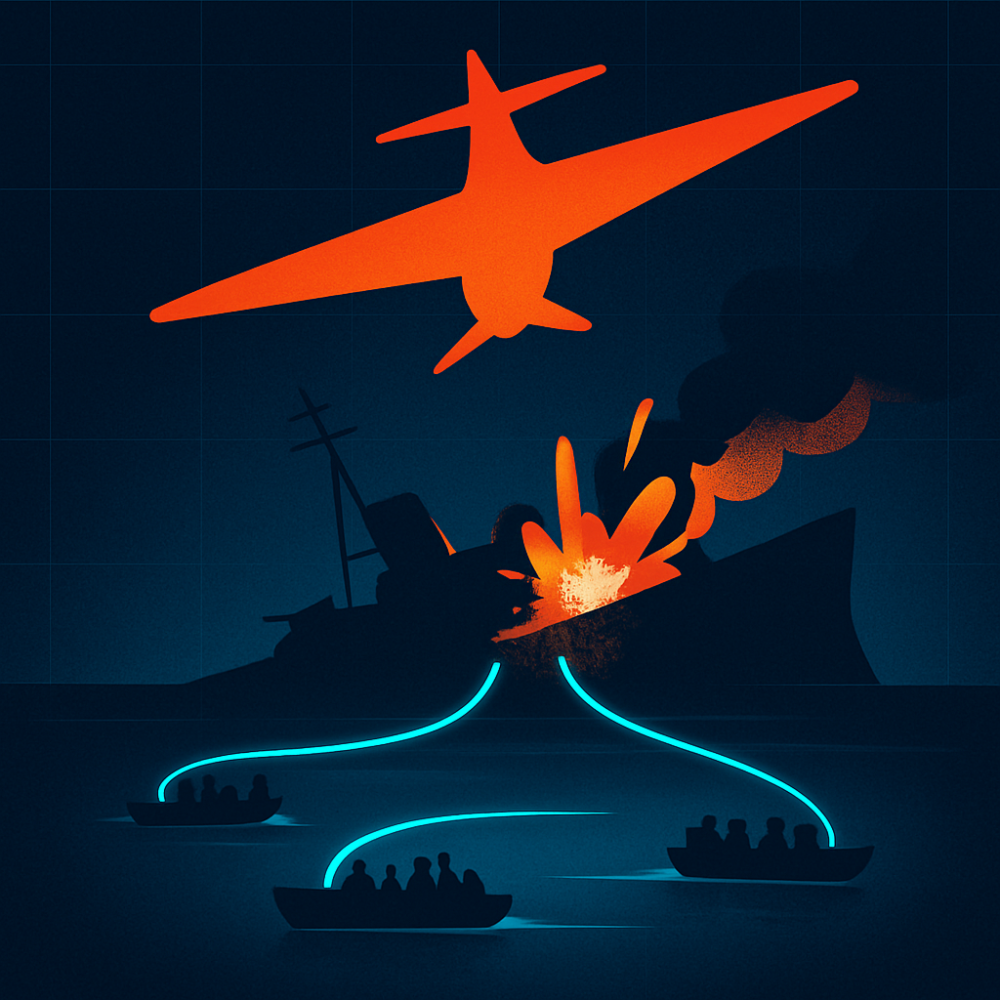
The East India Company Ran the World. Then It Ran Itself Into the Ground.
The most powerful corporation in history built extraordinary capability and never built the governance to hold it, and the way it destroyed itself is a management case study hiding inside an imperial one.
Series: Unconventional Leadership, Post #13
HistoricalThis post includes a Leadership Brief — an exclusive extended version.
What the East India Company Can Teach Today’s Business Leaders
Capability Without Governance Is a Countdown
The East India Company was the most powerful commercial organisation in history. It had its own army, its own navy, its own courts. It governed territories larger than most European nations. And it ran on a governance model that essentially said: make money, we’ll deal with the consequences later.
The consequences arrived. The exploitation of Bengal, the systematic extraction that caused famines, the corruption so endemic Parliament eventually had to step in — none of this was accidental. It was the inevitable output of a system built with extraordinary capability and almost no accountability to match it.
Every organisation builds capability first and governance second. That’s natural — you can’t govern what doesn’t exist yet. The mistake is assuming you can keep that ordering indefinitely. Capability without governance doesn’t plateau. It drifts toward the worst available outcomes, and the more capable the organisation, the faster it gets there.
Culture Is Built by What You Reward
The Company didn’t create corrupt officials. It created a system that made corruption the rational choice. Servants were paid modest salaries and sent thousands of miles away from oversight to preside over enormous wealth. The incentives were explicit: extract as much as you can personally before you’re rotated home. The culture followed the incentives, not the stated values.
This is what most organisations get backwards. They write values statements, run culture workshops, and build incentive structures that directly contradict them. Then they wonder why people behave in ways that conflict with the mission.
The Company’s servants weren’t exceptional villains. They were normal people responding rationally to the system they were placed in. Build a better system and most people will behave better. Build a worse one and no values statement will save you.
Extraction Doesn’t Scale
For a period, the Company’s extraction model produced extraordinary returns. The problem is that extraction works once per resource. You can drain a territory’s wealth — you cannot drain it twice.
The territories it had systematically stripped became less and less economically productive. The markets it had created became increasingly hostile. The local populations it had exploited became increasingly ungovernable. The model that had produced the returns began undermining the conditions that made the returns possible.
The translation to business: any model that extracts value from the people it serves rather than generating it with them is borrowing against a finite reserve. Short-term profitability and long-term viability are not the same calculation. The Company solved for one and destroyed the other.
The Genius Becomes the Bureaucracy
At its founding, the Company was a nimble, aggressive commercial enterprise that moved faster than any competitor. By its end, it was a vast, sclerotic administrative machine that spent as much energy maintaining itself as doing anything useful. The capability that built the empire became the bureaucracy that paralysed it.
Every organisation that succeeds dramatically faces this. The structures and hierarchies you build to manage success end up slowing the thing that produced the success in the first place. The innovators who built the operation retire into management. The startup that disrupted its market becomes the incumbent defending its position.
The answer isn’t to avoid building structure. It’s to treat your current model with the same scepticism you applied to your previous one: what got you here might not get you to the next place, and the time to notice that is before it becomes obvious.
The East India Company Ran the World. Then It Ran Itself Into the Ground.
What the most powerful corporation in history can teach the people running today’s
In 1803, a trading company headquartered in a five-storey building on Leadenhall Street commanded an army of 260,000 men. That was twice the size of the British Army. The company had its own navy, its own currency, its own flag, and its own foreign policy. It governed a fifth of humanity. It had started, two centuries earlier, as a group of London merchants who wanted a slice of the pepper trade.
The East India Company is usually told as a story about empire. I want to tell it as a story about management — because that is what it actually was. Every decision that built it and every decision that destroyed it was a business decision, made by businesspeople, for reasons that would be instantly recognisable to anyone who has sat in a modern boardroom. The scale was monstrous. The mechanics were ordinary.
And that is precisely what makes it useful. The EIC is not a fable about wickedness; the men who ran it were no worse than the average ambitious executive. It is a case study in what happens when an organisation’s capabilities outrun its conscience, when its systems outlive their purpose, and when nobody is willing to ask the only question that matters: what is this thing actually for?
Here is what 274 years of the world’s most audacious corporation can teach the people trying to build the next one.
The capabilities arrived. The governance never did.
Start with the achievement, because it was real. In an age without telegraph, refrigeration, accurate clocks, or trustworthy maps, the Company moved goods and money and people across fifteen thousand miles of ocean and turned a profit doing it. It pioneered financial instruments we still use. It standardised accounting practices. It built one of the first genuinely global logistics operations, and it did so with a head office of a few hundred people and a communication lag measured in years.
That last detail is the whole story. A letter to Calcutta took six months. A reply took six more. Which meant that the men making decisions on the ground — the “factors” and governors and military commanders scattered across Asia — were, for all practical purposes, unsupervised. London could set policy, but London could not enforce it, could not see what was happening, and frequently did not learn the truth until years after the damage was done.
The Company scaled its ambition magnificently and forgot to scale anything that might have restrained it. This is the oldest failure in business and the one every growing organisation walks straight into. A startup’s instincts work beautifully at fifteen people, where everyone can see everyone and trust does the work that process would otherwise have to. Those same instincts become a liability at fifteen hundred, and a catastrophe at the scale of a continent. Authority without oversight does not stay honest because you hope it will. It curdles. Always. The only variable is how long it takes and how far away the rot is before head office notices.
If your organisation is growing faster than its governance, you do not have a high-growth company. You have an unexploded one.
They paid for loyalty with salaries that made corruption rational.
The Company’s culture is where the lesson sharpens into something almost surgical. London wanted disciplined, loyal servants who would advance the firm’s interests above their own. So it hired ambitious young men, shipped them to the other side of the world, paid them very little, and placed them in positions of immense commercial power with effectively no supervision.
What did it expect to happen?
What happened was that they enriched themselves on a scale that beggars belief. Robert Clive — the man who effectively conquered Bengal for the Company — returned to England with a personal fortune that would run into the hundreds of millions in today’s money, extracted in a few short years. And Clive was not an aberration. He was the system working as designed. “Private trade,” the Company called it: employees running their own commercial ventures, taking gifts, levying their own informal taxes, all in direct competition with the employer whose ships had carried them there. It was institutionalised conflict of interest, and everyone above knew, and everyone above looked the other way, because the dividends kept arriving.
This is the most quietly instructive thing about the entire Company, and it is the lesson I have watched modern organisations relearn the hard way more times than I can count. Culture is not built by what you announce. It is built by what you reward. You can publish values, run the workshops, laminate the principles, and stick them on the wall — and if your incentive structure quietly makes the wrong behaviour the rational behaviour, you will get the wrong behaviour, every time, no matter how sincere the laminate. People are not stupid. They will read the actual signal underneath the stated one, and they will respond to that. The Company said it wanted integrity. It paid for plunder. It got exactly what it paid for.
When leadership knows about a problem and declines to act, that is not neutrality. Tacit permission is permission. The silence is the policy.
Then the bill came due.
For most of its history the Company existed under a comfortable assumption: that someone, ultimately, would underwrite it. The Crown provided legitimacy and naval support; the Company provided revenue and geopolitical leverage. It was a productive marriage, and the Company came to treat it as permanent.
It was not permanent, and the way the relationship ended should be read carefully by anyone whose business leans on a single great partner, a friendly regulator, a dominant customer, or a government contract they have started to assume is theirs by right. No partnership is unconditional. There is always a set of circumstances under which the other party walks away, and the time to understand those circumstances is long before you are standing in them.
But the deeper failure was not commercial dependency. It was the thing the Company built its whole position on and never actually possessed: legitimacy. It governed by charter and by force, but it never governed by consent. To the people whose lives it administered, it was an armed foreign corporation extracting wealth — and an organisation that rules without consent is not stable, it is merely quiet, and only until it isn’t.
And here is the fact this post has been walking toward, the one I refuse to put in a bullet point because it should not be made easy to skim past.
In 1770, in pursuit of revenue, the Company’s policies in Bengal turned a regional crop failure into a famine that killed an estimated ten million people. A third of the population. Not as an accident of war, but as a by-product of extraction — taxes raised even as people starved, grain hoarded, relief refused, because the model demanded a return and the men running it had been trained to deliver one regardless of cost.
Ten million dead is not a footnote in the Company’s story. It is the Company’s story, told honestly. Everything else — the logistics, the financial innovation, the staggering profits — was built on a willingness to externalise human cost without limit, and that willingness was not a bug in the model. It was the model.
This is what people miss when they talk about ESG as though it were a recent invention, a compliance fashion, a tax on doing business. The principle it encodes is ancient and it is brutal: the costs you push outside your balance sheet do not disappear. They accumulate. They compound. And they come back — as famine became rebellion, as rebellion became political catastrophe, as catastrophe made the Company ungovernable and, in the end, finished it. The communities you damage are the same communities you depend on. Ruin one and you have started a clock on the other.
ESG is not virtue. It is risk management with a long memory. The Company forgot, and the bill, when it came, was the largest in commercial history.
The genius that built it became the bureaucracy that strangled it.
There is a final movement to this story, and it is the one that should worry comfortable market leaders most.
The Company’s brilliance was forged under pressure. When you are insuring a cargo across an ocean that will swallow it without warning, when you are financing a voyage whose returns are two years away, when you are holding prices steady across a dozen markets you can only contact by ship — necessity makes you inventive, and the Company was inventive in ways that genuinely reshaped commerce.
Then it won. The monopoly was secured, the competition saw off, the returns assured. And the moment the pressure lifted, the inventiveness drained away. The Company grew bureaucratic, slow, allergic to change. The processes that had been a marvel in 1650 were a straitjacket by 1850 — and the organisation could no longer tell the difference, because the systems that made it successful had become the systems it mistook for success itself.
This is the trap of every incumbent that ever stopped having to fight. The hunger that builds a company is hard to manufacture once the company no longer needs it to survive, and an organisation that confuses its current processes with its actual purpose will defend those processes right up until they kill it. The Company did not lose because someone out-competed it on pepper. It lost because it forgot how to solve hard problems the moment it was no longer forced to, and its leadership — increasingly appointed by London connection rather than proven on the ground — frequently lacked the capability to manage what it had inherited. When the crisis came, there was no bench. There rarely is, in organisations that promote on relationship and call it strategy.
The receipts
The Company lasted 274 years, and then in 1874 it was quietly wound up — not bankrupted, not out-traded, but dissolved, because it had become a political and moral liability the British state could no longer afford to own. The most powerful corporation in the history of the world ended not with a collapse in the markets but with an act of Parliament, and a recognition, far too late, that the thing had never really been governable at all.
I am wary of tidy morals, and the Company does not offer one. “Be ethical” is too small. “Don’t get too big” is simply wrong — scale was never the sin. The lesson is harder and more specific than that, and it comes in a single line.
Capability without governance is not an asset. It is a loaded weapon you have handed to people you cannot see, in service of a purpose you have never bothered to define.
Every part of the Company’s ruin flows from that one failure. It built extraordinary capability and never built the governance to hold it. It scaled authority and never scaled accountability. It rewarded extraction and was astonished by corruption. It externalised human cost without limit and mistook the silence for stability. And it forgot, somewhere across those 274 years, that a corporation is supposed to be for something beyond the enrichment of the people who own it — and an organisation that forgets that will, given enough time and enough rope, consume itself.
None of this is comfortable. It is not meant to be. But the most audacious company in history kept meticulous records of exactly how it destroyed itself, and left them lying in plain sight for anyone willing to look.
We should at least do it the courtesy of reading them.
This is part of my Unconventional Leadership series, where I go looking for management lessons in unlikely places. If it landed, I’d genuinely like to know what you think — find me on LinkedIn or X. And if it made you look twice at how your own organisation handles the gap between capability and governance, that’s the conversation worth having.