What Admiral A. B. Cunningham Can Teach Today's Business Leaders
The Royal Navy's finest fighting admiral was aggressive, calm and ruinously loyal in equal measure, and his most contestable decisions reveal more about real leadership than any tidy parable ever could.
Series: Unconventional Leadership, Post #15
HistoricalThis post includes a Leadership Brief — an exclusive extended version.
What Admiral Cunningham Can Teach Today’s Business Leaders
Aggression Is a Posture Before It’s an Action
Cunningham understood something about naval warfare that translates directly into competitive strategy: aggression works even before you act aggressively. The reputation for attacking first, attacking hard, and not backing down changes the calculations your opponent makes long before any engagement happens. They hesitate. They hold back. They second-guess positions they’d otherwise commit to.
The same principle operates in business. The organisation known for moving fast, responding hard to competitive threats, and fighting for every market position creates a different environment than the one that responds cautiously or not at all. Your competitors are watching and drawing conclusions about what you’ll do. Those conclusions affect what they attempt. An aggressive posture is a competitive asset independent of any specific action it produces.
The mistake most cautious leaders make is treating aggression as inherently reckless. Cunningham was not reckless — he was deliberate and aggressive simultaneously. Those qualities are not opposites.
Calm Is Manufactured, Not Felt
At the Battle of Matapan, Cunningham made rapid, high-stakes decisions in conditions of enormous uncertainty and time pressure. He did not do this because he was naturally unafraid. He did it because he had developed the discipline to project calm when he didn’t feel it, and the preparation to trust his own judgement when clear thinking was hardest.
This is the piece of crisis leadership that most training programmes miss. Calm in a crisis is not a personality trait — it’s a manufactured output. It comes from thorough preparation (so you’re not encountering the problem for the first time), from disciplined habit (so your cognitive load is lower when stakes are highest), and from the deliberate decision to manage what you project rather than what you feel.
Your team takes its emotional cue from you. In a crisis, they are watching whether you believe it can be managed. That signal is more powerful than any specific instruction you give.
Loyalty Must Run Downward and Cost You Something
When the evacuation of Crete put the fleet at catastrophic risk, Cunningham was advised to stop the evacuations to preserve his ships. He refused. “It takes three years to build a ship. It takes three hundred years to build a tradition.” The evacuation continued. He lost ships. He saved tens of thousands of men.
The point isn’t that this was the strategically optimal decision — it may not have been. The point is what that decision communicated to every sailor in the Mediterranean Fleet: that Cunningham would not leave them behind to protect his assets. That loyalty ran downward, not just upward.
In my experience, loyalty that only flows up — that protects the organisation and its resources at the expense of the people doing the work — corrodes a team in ways that are very difficult to repair. The willingness to absorb a real cost to stand by your people is not sentiment. It’s the foundation of the trust that makes everything else function.
Nerve and Obstinacy Are Not the Same Thing
Cunningham held difficult positions under pressure. He fought for strategies he believed in when superiors disagreed. He did not do this uniformly — he knew when he was wrong and adjusted, and he knew when the situation had changed and the original plan no longer made sense.
This is the distinction most leaders struggle with: the difference between holding a position because you’ve thought it through and the evidence supports it, versus holding it because backing down feels like weakness. Nerve means staying the course when you’re right under pressure. Obstinacy means staying the course when you’re wrong because you’ve confused the position with your identity.
The test is simple but uncomfortable: when was the last time you changed your mind publicly, and without being forced to? A leader who never does this isn’t demonstrating nerve. They’re demonstrating that they’ve confused their judgement with their ego.
What Admiral A. B. Cunningham Can Teach Today’s Business Leaders
Lessons in Nerve, Judgement, and Loyalty from the Royal Navy’s Finest Fighting Admiral
On the night of 28 May 1941, the Mediterranean Fleet was sailing into a slaughter, and its commander knew it.
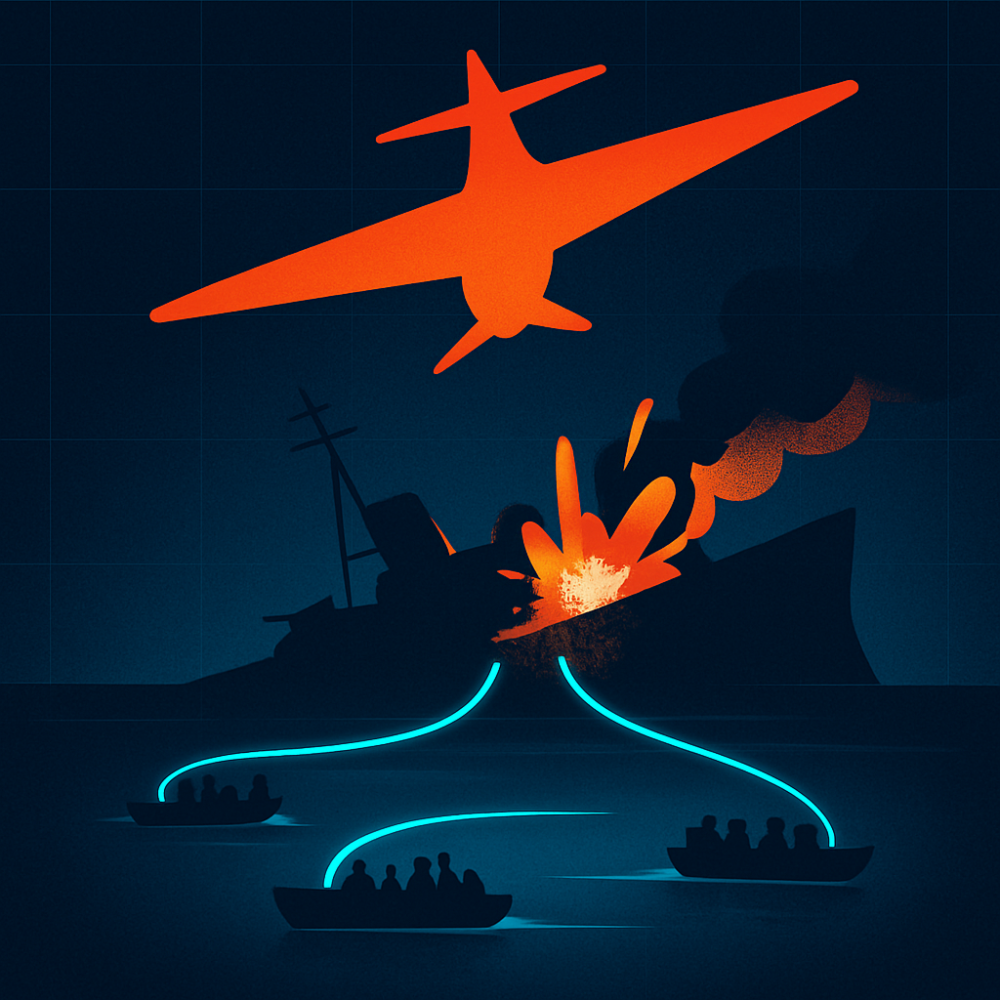
The British Army was trapped on Crete. The Germans owned the sky. Every hour the Royal Navy spent off those beaches lifting soldiers to safety was an hour spent under near-continuous air attack, with no fighter cover worth the name. Ships were being lost. More would be. Cunningham’s own staff — sober, capable men who could read a casualty return — told him plainly that to continue was to bleed away vessels the fleet could not replace.
He continued anyway. And the reason he gave has outlived almost every other thing said in that war.
Admiral of the Fleet Sir Andrew Browne Cunningham — “ABC” to the Navy that revered him — is not a tidy leadership parable, and I’d distrust anyone who served him up as one. He was aggressive to the point of recklessness, calm to the point of seeming cold, loyal to the point of bleeding his own command white. He got far more right than wrong, but the decisions that made him were genuinely contestable, and that is precisely why he’s worth your time. Real leadership lives in the contestable decisions. The easy ones don’t reveal anything.
Here’s what a working leader can actually take from him.
1. Aggression Is a Posture Before It Is an Action
Cunningham took over a Mediterranean theatre that the textbooks said he should lose. The Italian fleet was larger, newer in places, and operating in its own backyard, minutes from friendly ports. The prudent move was to husband his forces and wait.
He did the reverse, and he did it deliberately. From the first weeks he set a tone of relentless offensive intent — and that tone, more than any single order, is what shaped how the whole fleet fought.
The proof came at Taranto in November 1940. Twenty-one obsolescent Swordfish biplanes — string-bag torpedo aircraft that looked a generation out of date because they were — flew off a carrier at night and crippled the Italian battle fleet at its moorings. Three battleships hit, the naval balance of the Mediterranean tipped in an evening, by a force that wouldn’t have frightened anyone on paper. The Japanese took careful notes; a year later they applied the lesson at Pearl Harbor.
Strip out the cordite and the principle is one most organisations get backwards:
Posture sets culture before any decision is made. A leader who carries themselves with intent gives everyone below them permission to act with intent. A leader who radiates hesitation manufactures it at every level — and never knows they did. The disproportionate wins, the Tarantos, almost never come from the big obvious bet that everyone’s already braced for. They come from the unexpected angle applied to a high-value target with a force you were willing to risk because, properly handled, it wasn’t actually that much to lose.
We have, as a profession, become superb at managing downside and rather poor at seizing advantage. Cunningham would have found that timidity baffling.
2. Calm Is Something a Leader Manufactures for Others
The thing the men remembered about Cunningham on the bridge was that he didn’t flinch. Not because the danger didn’t reach him — it plainly did — but because he understood something that a lot of senior people never learn: a commander’s visible composure is not a personality quirk. It is a resource the entire organisation draws down on in a crisis.
When the bridge stays steady, the gun crews stay steady. The signal travels. So does the opposite.
This is the part that translates without any loss in the move from a flag bridge to a boardroom, because the human wiring is identical. When something goes badly wrong — the outage, the lost account, the launch that dies on contact with the market — your people read your face before they read the situation. Your calm is contagious. So is your panic, and panic produces panicked decisions, which produce a worse situation, which produces more panic. Cunningham broke that loop by refusing to enter it.
Note what his steadiness was not. It was not passivity, and it was not detachment. He was serene in manner and ferocious in intent at the same moment — and far from being contradictory, that pairing is the whole trick. Urgency of purpose, serenity of delivery. Most people can manage one. The leaders worth following hold both.
3. Loyalty Has to Run Downward First, and It Has to Cost You
So we come back to Crete, because everything that matters about Cunningham is in that decision.
The arithmetic was brutal and his staff laid it out without flinching: keep the fleet off those beaches and you will lose ships you cannot get back, for soldiers the Army arguably should never have left so exposed. The cold calculation pointed one way. Preserve the hardware. Cut the losses. Live to fight on terms of your own choosing.
Cunningham’s answer became one of the most quoted lines in naval history:
“It takes three years to build a ship; it takes three centuries to build a tradition. The evacuation will continue.”
And it did. The Navy took savage losses lifting the Army off Crete — but it did not leave the soldiers on the beach. What Cunningham grasped, and what his more rational advisers had momentarily lost sight of, was that the real asset under threat wasn’t the steel. It was the promise. The unbreakable contract that the Navy would always come for the Army was the actual source of the fleet’s fighting power, and the day that promise died, every hull in the Mediterranean would be worth less.
This is the lesson that has a price tag, and the price tag is the point:
Trust is the only genuinely irreplaceable thing a leader holds. Capital, tooling, headcount, kit — all replaceable, all sourceable, all rebuildable. The belief your people carry that you will stand by them when standing by them hurts is none of those things, and once you spend it you do not get it back at any price. Which is why loyalty proven in comfort proves nothing. Backing your team when it’s cheap is the table stakes of being a decent person; it tells no one anything about you. Cunningham’s loyalty meant what it meant because it was ruinously expensive, and he paid it in full, in public, with his most irreplaceable assets going down in front of him.
The leader who protects the balance sheet by quietly abandoning their people will, often enough, win the quarter and lose the institution — and won’t connect the two events until it’s far too late. You learn what an organisation actually values by watching what it’s willing to sacrifice in the one moment sacrifice is genuinely required. Everything before that is a press release.
4. Know the Razor’s Edge Between Nerve and Obstinacy
Now the uncomfortable part, because a deep dive that canonised the man would be lying to you.
Crete saved the Navy’s honour and it cost a savage material price, and intelligent people have argued ever since about whether the trade was sound. That argument is not disrespect — it’s the most honest tribute you can pay a hard decision. Because here is the thing nobody likes to say out loud: had Crete gone a little worse, that magnificent line about three centuries would read today as the epitaph of a man who threw a fleet away for a gesture.
The same trait was the virtue and the risk. It always is.
We lionise the leaders whose stubbornness happened to pay off, and we quietly file away the ones whose identical stubbornness sank them, and we almost never put the two groups side by side and notice they did the same thing. Survivorship bias flatters the bold and buries the brave-but-wrong in the same unmarked grave. Holding your nerve is a genuine virtue. Refusing to update when the facts have moved is its counterfeit twin, and from the inside, in the moment, under pressure, they feel exactly alike. The entire skill is telling which one you’re actually in — and conviction without a stop-loss isn’t courage, it’s just a slower way of being wrong.
So take Cunningham’s resolve. Take all of it. But take it with the humility to keep asking, when the cost starts climbing, whether you are being brave or merely being unable to admit you were wrong. He got the answer right at Crete. The margin was thinner than the legend lets on.
5. You Earn the Right to Ask Hard Things by Knowing the Craft
Cunningham was no boardroom admiral parachuted in to manage from a distance. He came up through destroyers. He knew ships and he knew the sea in his hands and his gut, and — this is the part that mattered operationally — his people knew that he knew. His authority wasn’t conferred by the braid on his sleeve. It was underwritten by competence.
When ABC ordered something near-impossible, the fleet obeyed differently than it would have for a man it suspected didn’t understand what he was asking. That difference is everything.
The parallel only sharpens as organisations get more abstract:
A leader who has done the work — or who takes the genuine trouble to understand it from the inside — commands a different quality of respect than one who manages purely through the dashboard, and the people doing the work can tell which kind they’ve got within about a week. You cannot delegate judgement you don’t possess; Cunningham could make fine operational calls under fire precisely because he understood the medium he was fighting in, and a leader detached from the substance of the work is making decisions in the dark and calling it strategy. None of which means you must be the best practitioner in the building. It means you must understand the building well enough that your hardest asks are credible — because an order the team doesn’t believe you understand is an order they’ll follow with their hands and not their heart, and on the worst day, hands aren’t enough.
Conclusion
Cunningham was aggressive when his peers were cautious, calm when the situation invited panic, and loyal when loyalty meant watching irreplaceable ships go down for a promise — and he was, on the most famous day of his career, arguably a hair too stubborn for his own fleet’s good. He is not a clean lesson. He is a real commander who made real, costly, arguable decisions and got the overwhelming majority of them right, which is the most any of us will ever manage.
Pull one thread and it’s this: leadership comes down to what you’ll spend and what you flatly refuse to. Cunningham would spend ships to keep faith with his people. He would not spend his fleet’s fighting spirit to buy himself a quieter night. Knowing which is which — and having the nerve to act on it while the cost is still mounting and the answer isn’t yet obvious — is the whole of the thing, and it’s what set him apart from the merely competent men around him who could read the same casualty returns and reached for the safer number.
The circumstances most of us lead in are immeasurably safer than his, which makes the standard he set more useful, not less. Hold your nerve. Back your people when it costs you something real. Master your craft well enough to earn the hard asks. And keep enough honesty in reserve to notice the moment resolve curdles into obstinacy — because that moment will come dressed exactly like courage, and it will be on your worst day, and no one will tell you which one it is.
He’d have expected you to work that out for yourself.