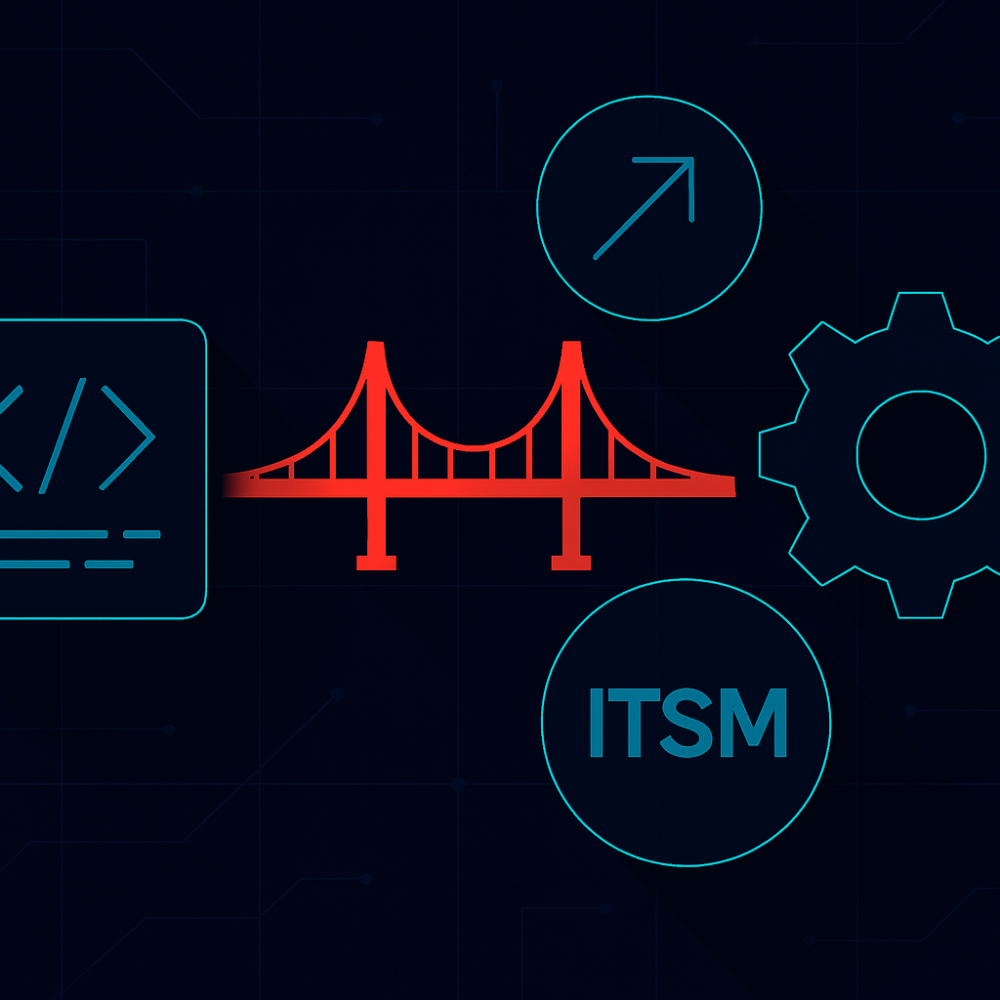
When ITSM Meets Enterprise Architecture: Two Worlds, One Goal
ITSM and Enterprise Architecture are often treated as separate disciplines — but that separation is where a lot of IT friction quietly originates. Here's why these two functions are more intertwined than most realise.
When ITSM Meets Enterprise Architecture: Two Worlds, One Goal
The relationship between IT Service Management and Enterprise Architecture is one of the most underappreciated dynamics in modern IT organisations. They are often treated as separate disciplines — different teams, different tools, different conversations. In my experience, that separation is where a lot of the friction in IT delivery quietly originates. Here’s a look at why these two functions are more intertwined than most people realise, and what happens when you get that relationship right.
1. Understanding the Two Disciplines
Before exploring the interaction, it’s worth grounding both disciplines clearly.
ITSM — anchored in ITIL® — is concerned with how services are delivered and supported. It governs the day-to-day operational practices that keep IT running: Incident Management, Change Management, Problem Management, Service Request fulfilment, and Service Level Management. ITSM is the operational heartbeat of IT.
Enterprise Architecture (EA), by contrast, operates at a strategic altitude. It defines the structural design of an organisation’s people, processes, information, and technology. EA produces roadmaps, reference architectures, and governance standards that guide where IT is heading, not just how it behaves today.
In simple terms: EA designs the building. ITSM runs it.
2. Where the Two Worlds Collide
The interaction between ITSM and EA happens whether you plan for it or not. The question is whether that interaction is structured and productive, or accidental and costly.
Here’s where the two functions most naturally intersect:
- Service Design — Every new service or significant change should be shaped by architectural principles before it lands in an ITSM Service Design Package. EA sets the constraints; ITSM determines the support model.
- Change Management — Significant changes to the IT landscape should always be assessed against the current and target architecture. Without that lens, Change Management risks approving changes that create technical debt or architectural drift.
- Configuration Management & the CMDB — A well-maintained CMDB is as much an architectural asset as it is an operational one. EA needs accurate data about the IT landscape to plan effectively; ITSM needs it to manage services. The CMDB is shared territory.
- Continual Improvement — Operational insight from ITSM (incident trends, recurring problems, degraded SLAs) should directly inform architectural decisions. If a particular platform is generating disproportionate incident volume, that’s a signal EA needs to hear.
3. The Feedback Loop That Most Organisations Are Missing
In my opinion, the most valuable — and most neglected — aspect of the ITSM/EA relationship is the feedback loop running from operations into architecture.
EA teams are often excellent at producing future-state blueprints. What they sometimes lack is rich, grounded operational data to validate their assumptions. ITSM sits on a goldmine of that data: availability metrics, failure patterns, user experience trends, support cost by service. When that data flows systematically into EA’s planning process, the resulting architecture is far more pragmatic and resilient.
Equally, when EA teams engage early with ITSM during service design — rather than handing over a completed blueprint — the resulting support model is better aligned with operational reality from day one.
The organisations that do this well tend to have a shared governance forum where both functions come together, a common language around services and components, and — critically — mutual respect for what each discipline contributes.
4. Practical Steps to Strengthen the Relationship
If you’re looking to improve the ITSM/EA relationship in your organisation, here are some tangible starting points:
- Establish a shared service catalogue taxonomy — Agree on how services, applications, and infrastructure components are named and classified. Inconsistent nomenclature is a surprisingly common barrier.
- Include ITSM representation in Architecture Review Boards — Operational insight should have a seat at the table when architectural decisions are made.
- Feed ITSM data into EA tooling — Whether that’s incident volumes, CMDB exports, or SLA breach data, make operational information accessible to your architects.
- Align your roadmaps — ITSM improvement roadmaps and EA technology roadmaps should be reviewed together at least quarterly. Conflicting priorities are far easier to resolve early.
- Co-author Service Design Packages — Rather than treating SDPs as a purely ITSM artefact, bring your architects in. The result will be a more coherent, deliverable design.
Final Thoughts
ITSM and Enterprise Architecture are not competing disciplines — they are complementary ones. ITSM keeps services running; EA ensures those services are worth running. When the two functions operate in isolation, IT organisations tend to accumulate technical debt, suffer from misaligned priorities, and struggle to demonstrate strategic value to the business.
Getting the relationship right requires intentional effort: shared language, structured feedback loops, and genuine collaboration across what are often quite different professional cultures. It is worth the investment.
Hopefully this has been useful to you and I wish you well on your ITSM journey…