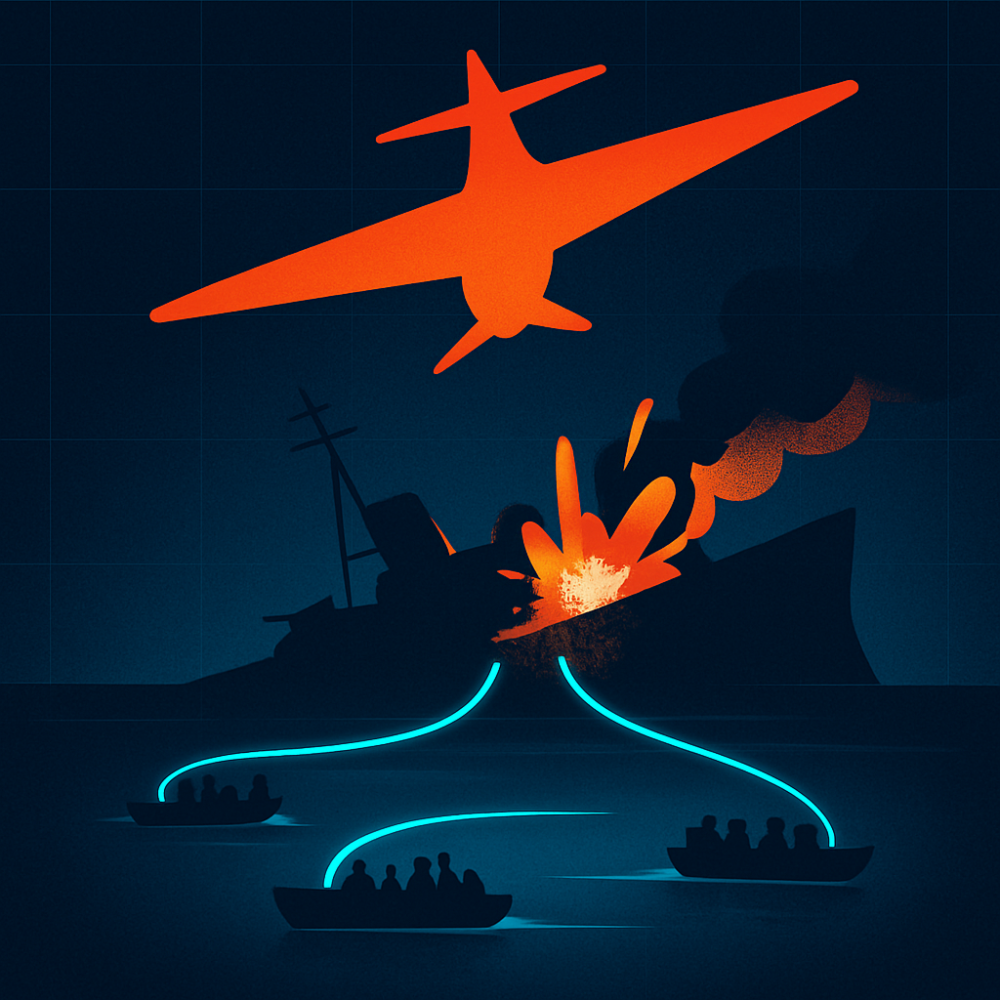
What Star Wars Can Teach Today's Business Leaders
From Darth Vader's fear-based management to Yoda's servant leadership, Star Wars offers surprisingly rich lessons for modern business leaders.
Series: Leadership, Post #9
Sci-FiThis post includes a Leadership Brief — an exclusive extended version.
What Star Wars Can Teach Today’s Business Leaders
A long time ago in a galaxy far, far away… someone made some catastrophically bad leadership decisions. Sound familiar?
I’ll be honest with you. I didn’t expect a space opera about laser swords and smugglers to become one of the richest leadership case studies I’ve ever encountered. But here we are.
Over nearly five decades, Star Wars has given us heroes, villains, bureaucrats, visionaries, and every leadership archetype in between. Strip away the special effects and the mythology, and what you’re left with is an extraordinarily human story about power, purpose, culture, and the choices that define organisations — and the people who lead them.
So whether you’re running an IT service desk or steering a global enterprise, there’s something in this saga for you. Let’s take a walk through the galaxy.
1. Culture Eats Strategy — Even in the Empire
The Galactic Empire is, on paper, an organisational marvel. Centralised command. Clear hierarchy. Enormous resources. Consistent branding (all those matching uniforms). And yet it collapses, spectacularly and repeatedly.
Why? Because its culture was built entirely on fear.
Fear is a powerful short-term motivator. Darth Vader’s management style — summarised neatly as “I find your lack of faith disturbing” — produces compliance, but not commitment. Officers don’t flag problems because they fear the consequences. Nobody speaks truth to power. Risk is hidden rather than managed. Innovation is suppressed rather than encouraged.
Sound like anywhere you’ve worked?
The Rebel Alliance, by contrast, is a coalition of people who want to be there. Their resources are inferior. Their structure is looser. But they are driven by shared belief, psychological safety, and — crucially — leaders who actually listen. Luke asks questions. Leia collaborates. Han Solo brings an irreverent challenge that nobody else will voice but everyone benefits from.
The lesson: A fear-based culture will meet its Death Star moment eventually. Psychological safety, shared mission, and the freedom to raise bad news early are not soft values — they are organisational resilience mechanisms.
2. The Hubris Trap: When Confidence Becomes a Liability
“Don’t be too proud of this technological terror you’ve constructed.”
Admiral Motti, in the very first film, is so confident in the Death Star that he dismisses the Force entirely. His certainty blinds him to risk. And Vader, for all his faults, clocks it immediately.
Hubris is one of the most consistent failure modes in senior leadership. I’ve seen it in enterprise IT programmes. I’ve seen it in service transformation projects. The moment a leadership team becomes so invested in a solution — a platform, an architecture, a strategy — that they can no longer hear the dissenting voices, the warning signs get ignored.
The Death Star had a single-point vulnerability baked into its design. It was reported. It was dismissed. The rest is history. Twice.
This is not a fictional quirk. It mirrors every major IT disaster, failed product launch, or corporate collapse where the post-mortem reveals that someone knew — they just weren’t heard, or didn’t feel safe enough to escalate.
The lesson: Build formal mechanisms for dissent. Red teams, pre-mortem workshops, architecture review boards — whatever fits your context. Make it structurally safe to say “I think we have a problem.” Then actually listen.
3. Yoda and the Art of Servant Leadership
Yoda is, technically, one of the most powerful beings in the galaxy. He is also 900 years old, lives in a swamp, and spends his time teaching a single student with zero compensation and no KPIs in sight.
He is the archetypal servant leader.
He doesn’t lead through rank — he gave that up. He leads through wisdom, patience, and an absolute commitment to developing others rather than serving his own interests. He asks questions instead of issuing answers. He challenges Luke not to make himself feel important but to unlock something in Luke that Luke can’t yet see in himself.
Compare this to Emperor Palpatine: technically brilliant, supremely capable, but laser-focused on accumulating personal power. He builds nothing that outlasts him. Everything he creates is dependent on him. The moment he’s gone, it crumbles.
The lesson: The measure of a leader isn’t what they accomplish while they’re in the room. It’s what continues — and what grows — after they leave. Invest in your people. Build capability, not dependency. The best leaders make themselves progressively less necessary.
4. Han Solo and the Value of the Trusted Contrarian
Every leadership team needs a Han Solo.
Not because they’re charming (though it helps). Because they are the person most likely to say “I’ve got a bad feeling about this” when everyone else is nodding along. Han is the pragmatist in a room of idealists. He asks awkward questions about feasibility, cost, and the basic physics of the plan.
In a well-functioning team, this is gold. In a poorly-functioning team, it’s a threat.
Too many organisations unconsciously select for agreement. The people who get promoted are the ones who champion the party line. The contrarians are managed out, reassigned, or simply learn to shut up. And the organisation becomes progressively more homogeneous in its thinking — right up until it flies into an asteroid field.
Han also demonstrates something else: the value of knowing when to commit. He’s sceptical, he argues, he raises objections — and then, when the decision is made, he shows up at the Battle of Yavin when it matters most. Productive dissent followed by genuine commitment is what distinguishes a trusted contrarian from a disruptive one.
The lesson: Actively recruit for cognitive diversity. Create space for challenge before decisions are made. Then expect full commitment once the direction is set. And for the love of all things holy, let your Han Solos speak before the mission launches, not after.
5. Anakin Skywalker: The Cautionary Tale of the High-Potential Leader
Anakin’s arc is the most instructive in the entire saga — and the most uncomfortable — because it is entirely believable.
He is talented beyond measure. His trajectory is extraordinary. But he carries unresolved trauma, is placed under inadequate mentorship at critical moments, and is never given a genuine sense of psychological safety. His fears are met with platitudes (“Train yourself to let go of everything you fear to lose”) rather than proper support.
And so when a figure of authority — Palpatine — offers him what the institution never did (understanding, acceptance, a direct answer to his most urgent fear), he goes. All that talent, all that potential, redirected against the very organisation that developed him.
This is not a story about good and evil. It’s a story about talent management failure.
How many organisations lose their best people to competitors, or watch them disengage entirely, because they failed to notice the warning signs? How many high-potential individuals leave for a rival who simply listened better?
Anakin’s warning signs were visible for years. The Council noticed the issues but didn’t act meaningfully. Obi-Wan cared deeply but struggled to connect authentically on the things that mattered most. The institution was so focused on Anakin’s capability that it overlooked his wellbeing.
The lesson: Talent without proper support is a liability risk, not just a performance opportunity. Know your high-potential people. Not their metrics — their motivations, their fears, their sense of belonging. And don’t wait for the exit interview to find out what went wrong.
6. The Mandalorian Principle: Purpose Over Process
“This is the Way.”
The Mandalorians are, in many respects, a process-obsessed culture. There are rules. There are codes. There are things that are simply done a certain way because they have always been done that way.
And yet the entire arc of The Mandalorian is about a character who learns to interrogate those rules — not to abandon them, but to understand the purpose behind them. What are we actually trying to protect? What does this code exist to achieve? And when the letter of the law conflicts with its spirit, which do you follow?
This is, almost exactly, the challenge facing organisations navigating digital transformation, service evolution, or any significant change programme. You will encounter processes that are followed rigorously but whose original purpose has long since been forgotten. You will find governance frameworks built for a world that no longer exists.
The answer is never simply “throw it all away.” The Armorer doesn’t abandon the Creed. But she does, eventually, apply wisdom rather than just rules.
The lesson: When reviewing your processes, always ask the foundational question: what is this for? If nobody can answer it, that’s your signal. Preserve intent. Interrogate implementation. And be very cautious of any organisation that mistakes adherence to process for delivery of outcomes.
7. The Rebellion’s Agility — and Its Limits
The Rebel Alliance wins, in large part, because it is small, adaptive, and willing to improvise. The trench run at the Battle of Yavin succeeds because Luke abandons the targeting computer and trusts his instincts. The assault on Scarif is largely improvised. The plan to destroy the second Death Star involves a significant amount of hoping for the best.
There is a genuine lesson here about agility, autonomy, and empowering people at the point of decision. Big organisations die on rigid, centralised decision-making. Speed matters. Context matters. The person closest to the problem often knows more than the person furthest from it.
But — and this is important — the Rebellion also demonstrates the limits of pure improvisation.
The sequel trilogy’s New Republic is so committed to not becoming what it fought against that it dismantles the very institutional capacity it needs to respond to new threats. The First Order builds in the shadows, largely unchallenged, because the Republic cannot agree on whether to have a functioning military. Decentralised, values-driven, democratically accountable governance is a genuine good. But it requires institutional memory, risk sensing, and the willingness to act on uncomfortable intelligence.
The lesson: Agility and governance are not opposites. The best organisations are both responsive and resilient. They empower teams to move fast within a framework designed to catch what individual judgement might miss.
8. Luke Skywalker and the Obligation to Keep Learning
Here is something that doesn’t get said often enough about Luke Skywalker: he gets things badly wrong.
Not once. Repeatedly. He rushes to Bespin when Yoda and Obi-Wan tell him not to. He nearly starts a new golden age of Jedi and then nearly ends it in a single moment of fear-driven poor judgement. He goes into exile rather than facing the consequences of his failures.
And then, eventually, he comes back.
The defining characteristic of Luke’s leadership journey isn’t his victories. It’s his willingness — eventually — to keep going after failure. To acknowledge what he got wrong. To accept that mastery is not a destination, it’s a direction.
In The Last Jedi (whatever you think of it), Luke’s redemption arc is fundamentally about a leader who allowed failure to calcify into paralysis, and who has to consciously choose to re-engage with the world. That is, for many senior leaders in organisations, a deeply recognisable story.
The lesson: Leadership is not a credential you earn once. The moment you stop learning — from feedback, from failure, from the people around you — you begin to decline. Build time for reflection. Seek out the people who will tell you what you got wrong. And be very suspicious of any leader, yourself included, who hasn’t had a meaningful failure in a while. Either they’re not taking enough risk, or they’re not being honest with themselves.
Final Thought: May the Force Be With Your Org Design
The Force, in Star Wars, is described in many ways. But its most useful definition, for our purposes, is the energy that connects all living things — the invisible force multiplier that transforms individual capability into something greater than the sum of its parts.
That’s culture. That’s trust. That’s psychological safety, shared purpose, and the sense that what you’re doing actually matters.
You can build the Death Star. You can have the processes, the platforms, the governance frameworks, the org charts. But if the Force isn’t with you — if your people aren’t genuinely connected to the mission and to each other — a single proton torpedo will find the exhaust port eventually.
Build the culture. Develop the people. Listen to the Yodas in the room.
The rest tends to follow.
What leadership lessons have you drawn from unexpected places? I’d love to hear them — drop me a message or connect with me on LinkedIn.
— Steven
What Star Wars Can Teach Today’s Business Leaders
What the man who mocked the Force reveals about hubris, talent, and the cultures that collapse
A long time ago in a galaxy far, far away, a senior executive sat in a meeting and confidently dismissed the one risk that would shortly destroy his entire organisation. Sound familiar?
The man’s name was Admiral Motti, and the meeting was a briefing aboard the Death Star in the very first film. The Empire had just built the most powerful weapon in the galaxy — a battle station the size of a moon, capable of destroying a planet — and Motti, flush with the confidence that comes from standing inside something that enormous, turned to Darth Vader and openly ridiculed his faith in the Force. He called it a sad devotion to an ancient religion, and boasted that it had not helped Vader conjure up the stolen plans or divine the rebels’ hidden location. He was so certain of the technological terror he was standing in that he dismissed the only threat that mattered.
Vader, for all his considerable faults, clocked it instantly, and — in a gesture that has launched a thousand management-style jokes — began to choke the admiral from across the table, observing that he found the man’s lack of faith disturbing. But strip away the theatrics and look at what Motti actually represents, because it is the most consistent failure mode in senior leadership there is. Motti had become so invested in a solution — the station, its scale, its apparent invulnerability — that he could no longer hear the dissenting signal. And the dissenting signal, in this case, was correct. The Death Star had a single-point vulnerability designed into it. It had been reported. It was about to be exploited by a young pilot and a handful of torpedoes, and the most powerful object in the galaxy was about to be undone by the one weakness its own leadership had been too proud to take seriously.
I did not expect, when I first sat down to rewatch it, that a space opera about laser swords and smugglers would turn into one of the richest leadership case studies I have ever encountered. But across nearly five decades, Star Wars has given us every leadership archetype imaginable — the visionary, the tyrant, the mentor, the high-potential who goes catastrophically wrong — and underneath the special effects and the mythology it is an extraordinarily human story about power, purpose, culture, and the choices that define organisations and the people who lead them. Motti’s moment of fatal certainty is the right thread to pull, because hubris — the confidence that curdles into a liability — is woven through the entire saga, and because the antidote to it turns out to be the thing the Empire most conspicuously lacks.
That antidote is a culture in which the dissenting voice can survive, and the saga’s central irony is that the Empire, an organisational marvel on paper, never builds one. Centralised command, clear hierarchy, vast resources, consistent branding right down to the matching uniforms — and it collapses, spectacularly and repeatedly, because its culture is built entirely on fear. Fear is a genuinely powerful short-term motivator, and Vader’s management style produces compliance with impressive reliability. What it cannot produce is commitment, or candour, or early warning. Officers do not flag problems because flagging problems is how you end up choked across a conference table; nobody speaks truth to power because power has made the cost of truth explicit; risk gets hidden rather than managed, and the exhaust port stays unaddressed. The Rebel Alliance, by every material measure inferior — fewer resources, looser structure, no Death Star — wins in large part because it is a coalition of people who actually want to be there, bound by shared belief and a freedom to raise bad news early that the Empire has engineered out of existence. Luke asks questions. Leia collaborates. Han brings an irreverent challenge nobody else will voice but everyone benefits from. A fear-based culture meets its Death Star moment eventually, and the lesson is not soft: psychological safety, shared mission, and the freedom to escalate a concern before it becomes a crisis are not pleasant extras. They are the mechanisms by which an organisation senses danger in time to survive it.
The deeper reason the Empire cannot correct course is that hubris and a fear culture reinforce each other in a closed loop, and breaking that loop requires building the very thing fear destroys: structural permission to dissent. Motti’s overconfidence and the silence around him are the same failure viewed from two angles — the leader too certain to listen, and the followers too frightened to make him. This is not a fictional quirk; it mirrors essentially every major IT disaster, failed product launch and corporate collapse where the post-mortem reveals that someone knew, and either was not heard or did not feel safe enough to escalate. The Death Star’s flaw was reported and dismissed. So the corrective has to be structural rather than merely cultural good intentions: formal mechanisms for dissent — red teams, pre-mortems, architecture review boards, whatever fits the context — that make it not just permitted but expected to say “I think we have a problem,” and then, crucially, leadership that actually listens when someone does. Without that structure, you are relying on individual courage to overcome institutional fear, and that is a bet the Empire lost twice with the same exhaust port.
If the Empire shows you the failure, the saga is generous enough to show you the alternative, and it lives in a swamp. Yoda is, technically, one of the most powerful beings in the galaxy, and he spends his time teaching a single student, for no compensation, with no rank, no title, and no KPIs in sight. He is the archetypal servant leader, and the contrast he draws with the Emperor is the saga’s clearest statement about what leadership is actually for. Yoda leads through wisdom and patience and an absolute commitment to developing someone else rather than aggrandising himself; he asks questions rather than issuing answers, and he challenges Luke not to feel important but to unlock something in Luke that Luke cannot yet see. Set that against Palpatine — technically brilliant, supremely capable, and laser-focused on accumulating personal power — who builds nothing that outlasts him, whose every creation is dependent on him, and whose entire apparatus crumbles the moment he is gone. That is the whole lesson, and it is uncomfortable for any leader who measures themselves by their presence in the room: the real measure of leadership is not what you accomplish whilst you are there, but what continues and grows after you leave. Yoda invests in capability. Palpatine builds dependency. One creates a Jedi who outlives his master; the other creates an empire that dies with its architect. The best leaders, like the better of these two, make themselves progressively less necessary.
The saga also makes a quieter argument about the value of a particular kind of person every leadership team needs and most teams quietly drive out — the trusted contrarian, who in this story is Han Solo. Han is the pragmatist in a room of idealists, the one most likely to say he has a bad feeling about this when everyone else is nodding along, the one who asks the awkward questions about feasibility and cost and the basic physics of the plan. In a well-functioning team this is pure gold; in a poorly functioning one it reads as a threat, and that is exactly the problem, because too many organisations unconsciously select for agreement. The people who get promoted are the ones who champion the party line; the contrarians get managed out, reassigned, or simply learn to keep quiet, and the organisation grows steadily more homogeneous in its thinking right up until it flies into an asteroid field. But Han demonstrates the other half of the bargain too, the half that separates a trusted contrarian from a merely disruptive one: he is sceptical, he argues, he raises objections — and then, once the decision is made, he turns up at the Battle of Yavin at the decisive moment. Productive dissent followed by genuine commitment is the whole package. So recruit for cognitive diversity, create real space for challenge before the decision is taken, expect full commitment once the direction is set — and, for the love of all things, let your Han Solos speak before the mission launches rather than after.
The most instructive arc in the entire saga, and the most uncomfortable, is Anakin Skywalker’s, because it is not a story about good and evil at all. It is a story about talent management failure, and it is entirely believable. Anakin is gifted beyond measure, on an extraordinary trajectory, and he carries unresolved trauma into an institution that places him under inadequate mentorship at the critical moments and never gives him a genuine sense of psychological safety. His fears are met with platitudes — train yourself to let go of everything you fear to lose — rather than with proper support. And so when a figure of authority finally offers him what the institution never did, understanding and acceptance and a direct answer to his most urgent fear, he goes, and all that talent and potential is redirected against the very organisation that developed him. The warning signs were visible for years. The Council noticed the issues and did not act meaningfully; Obi-Wan cared deeply but struggled to connect authentically on the things that actually mattered; the institution was so fixated on Anakin’s capability that it overlooked his wellbeing entirely. How many organisations lose their best people to a competitor, or watch them quietly disengage, because they failed to notice the same signs — because they tracked the metrics and never asked about the motivations, the fears, the sense of belonging? Talent without proper support is not simply a performance opportunity; it is a liability risk. Know your high-potential people as people, and do not wait for the exit interview to discover what went wrong.
Two further lessons round out the saga, and the first is about the danger of process that has forgotten its purpose. The Mandalorians are a deeply process-bound culture — there are rules, there are codes, there are things simply done a certain way because they have always been done that way, and the whole arc of the character is about learning to interrogate those rules without abandoning them. What are we actually trying to protect? What does this code exist to achieve? And when the letter of the law collides with its spirit, which do you follow? This is precisely the challenge facing any organisation navigating transformation, where you will inevitably encounter processes followed rigorously long after their original purpose has been forgotten, and governance frameworks built for a world that no longer exists. The answer is never simply to throw it all away — the more thoughtful Mandalorians do not abandon their creed; they apply wisdom rather than mere rules to it. So when reviewing your own processes, ask the foundational question of every one: what is this for? If nobody can answer, that is your signal. Preserve the intent, interrogate the implementation, and be deeply suspicious of any organisation that has mistaken adherence to process for delivery of outcomes.
The second is about the limits of pure improvisation, and it is the lesson that complicates the easy moral of the original films. The Rebellion wins because it is small, adaptive, and willing to improvise — Luke abandons the targeting computer and trusts his instincts, the assault on Scarif is largely made up on the fly — and there is a genuine lesson here about agility, autonomy, and empowering people at the point of decision, because big organisations do die on rigid, centralised decision-making, and the person closest to the problem often knows more than the person furthest from it. But the saga is honest enough to show the other edge of the blade. The New Republic that follows is so determined never to become the thing it fought that it dismantles the very institutional capacity it needs to sense and respond to a new threat, and the First Order builds in the shadows, largely unchallenged, because the Republic cannot agree on whether to maintain a functioning military at all. Decentralised, values-driven, accountable governance is a real good — but it requires institutional memory, risk-sensing, and the willingness to act on uncomfortable intelligence. Agility and governance are not opposites. The best organisations are both responsive and resilient, empowering teams to move fast within a framework designed to catch what individual judgement alone would miss.
There is one last thing worth saying about Luke, because it does not get said often enough: he gets things badly wrong, repeatedly, and that is the most useful thing about him. He rushes to Bespin when his teachers tell him not to. He nearly builds a new golden age of the Jedi and then nearly ends it in a single moment of fear-driven misjudgement. He retreats into exile rather than face the consequences of his failures. And then, eventually, he comes back. The defining characteristic of his leadership journey is not his victories but his willingness — eventually — to keep going after failure, to acknowledge what he got wrong, to accept that mastery is not a destination but a direction. For a great many senior leaders that is a deeply recognisable story: the failure that calcifies into paralysis, and the conscious choice required to re-engage with the world rather than hide from it. Leadership is not a credential you earn once. The moment you stop learning — from feedback, from failure, from the people around you — you begin to decline, and you should be suspicious of any leader, yourself included, who has not had a meaningful failure in a while. Either they are not taking enough risk, or they are not being honest with themselves about the ones they took.
Final Thought: May the Force Be With Your Org Design
The Force is described many ways across the saga, but the most useful definition for our purposes is the one that calls it the energy that connects all living things — the invisible multiplier that turns individual capability into something greater than the sum of its parts. That is culture. That is trust, psychological safety, shared purpose, and the genuine sense that what people are doing actually matters. You can build the Death Star. You can have the processes, the platforms, the governance frameworks, the org charts, all of it. But if the Force is not with you — if your people are not authentically connected to the mission and to each other — a single proton torpedo will find the exhaust port eventually, exactly as Admiral Motti discovered whilst boasting about how invulnerable he was. Build the culture. Develop the people. Listen to the Yodas in the room, and to the Han Solos, before the mission launches. The rest tends to follow.
What leadership lessons have you drawn from unexpected places? I’d love to hear them — drop me a message or connect with me on LinkedIn.
— Steven